The AI revolution is real. But for every business that has successfully deployed AI and seen genuine returns, there are dozens more who have burned thousands of dollars on tools that are underused, unreliable, or simply wrong for their actual needs.
This article is not about the promise of AI. It is about the practice of AI — how to implement it in a way that is reliable, cost-effective, and genuinely valuable for your specific business.
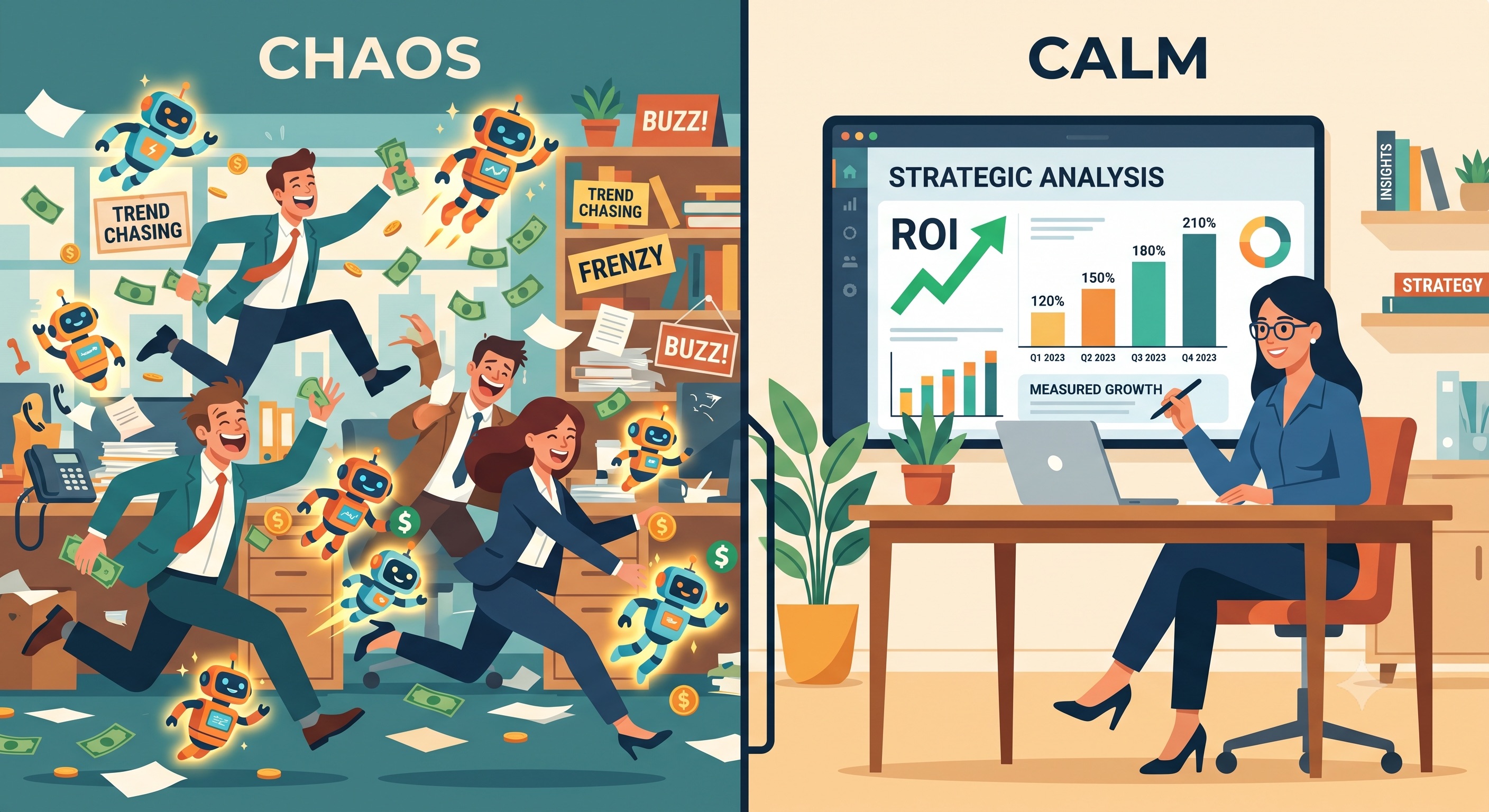
The #1 Mistake: Starting with the Technology, Not the Problem
Most failed AI projects share a common origin story. A business leader reads about the latest AI model, attends a conference, or gets pitched by a vendor. They come back excited and announce: “We need to integrate AI.”
The problem is that “integrating AI” is not a goal. It is a solution in search of a problem.
Before evaluating any AI tool or platform, you must be able to answer these three questions precisely:
- What specific business process consumes the most time or money today?
- What does the output of that process look like, and how do you know when it is done correctly?
- What would a 10x improvement in that process mean for your bottom line?
If you cannot answer all three, you are not ready to build. You are still in the hype phase.
“The businesses that win with AI are the ones that define the problem first and find the right tool second — not the other way around.”
Understanding the True Cost of AI Implementation
Vendors and consultants love to quote AI as “affordable.” And in terms of pure API costs, they are often right. But raw API costs are rarely the bulk of what you will spend. Here is what the real cost breakdown looks like:
Direct Costs
- AI provider API fees (OpenAI, Anthropic, Google, etc.)
- Infrastructure to host your AI pipeline — servers, databases, vector stores
- Third-party integrations with your existing tools
Hidden Costs
- Engineering time to build, test, and maintain the pipeline
- Data cleaning and preparation (often the single largest cost)
- Ongoing evaluation and monitoring to catch quality regressions
- Staff training and change management
Risk Costs
- Customer-facing errors caused by AI hallucinations
- Security vulnerabilities from improperly handled data
- Regulatory exposure if you operate in a compliant industry
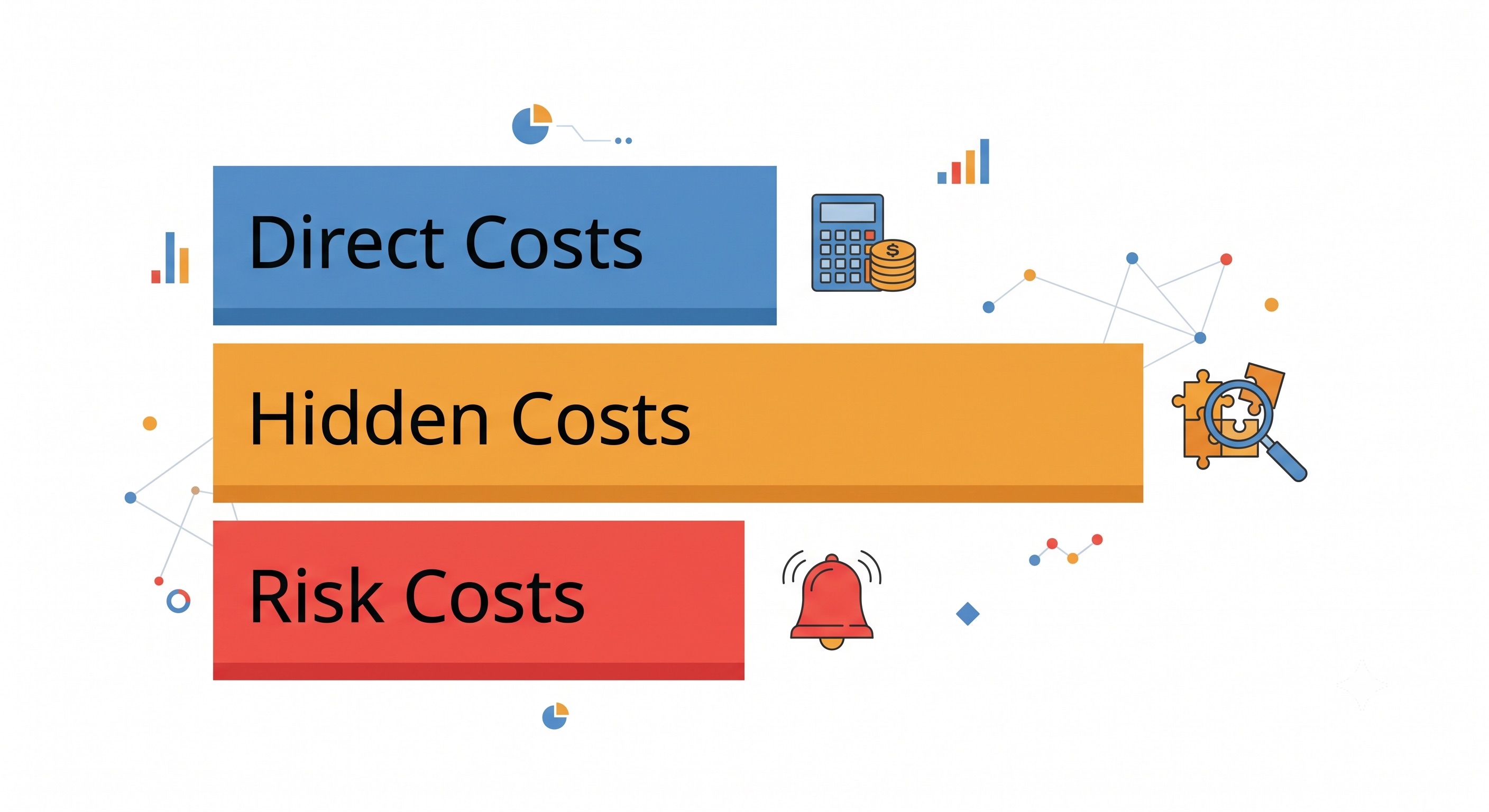
The goal of a well-designed AI project is not simply to minimize the first category — it is to minimize the total cost across all three by making smart architectural decisions upfront.
Build vs. Buy: Choosing the Right Approach
Not every AI problem requires a custom solution. Getting this decision right is one of the most high-leverage choices you can make.
When to Use Off-the-Shelf AI Tools
If your use case is generic and your data is not sensitive, existing tools are often the right answer:
- General writing assistance → Use ChatGPT, Copilot, or Gemini directly. There is no ROI in building your own wrapper when these products are already excellent.
- Simple customer-facing chat → SaaS chatbot platforms with built-in LLM integration handle straightforward FAQs well.
- Document or image processing → Many established APIs handle OCR, document parsing, and image recognition without any custom training.
When to Build a Custom AI Solution
Custom solutions become necessary when:
- Your data is proprietary or confidential. Sending sensitive customer records to a third-party API is a legal and security risk. A privately hosted model or a properly isolated pipeline is essential.
- Your workflow is highly specific. When an AI needs to understand your internal jargon, your pricing rules, your product catalog, and your approval chains, off-the-shelf tools constantly fall short.
- Reliability and auditability matter. In any context where an AI error could lead to a financial loss or a compliance violation, you need full logging, traceability, and the ability to override outputs.
- You are processing high volume. At scale, per-call API fees to a vendor can become very expensive compared to running your own optimized pipeline.
Building for Reliability: The Non-Negotiables
This is where most AI projects cut corners — and where the most expensive failures happen.
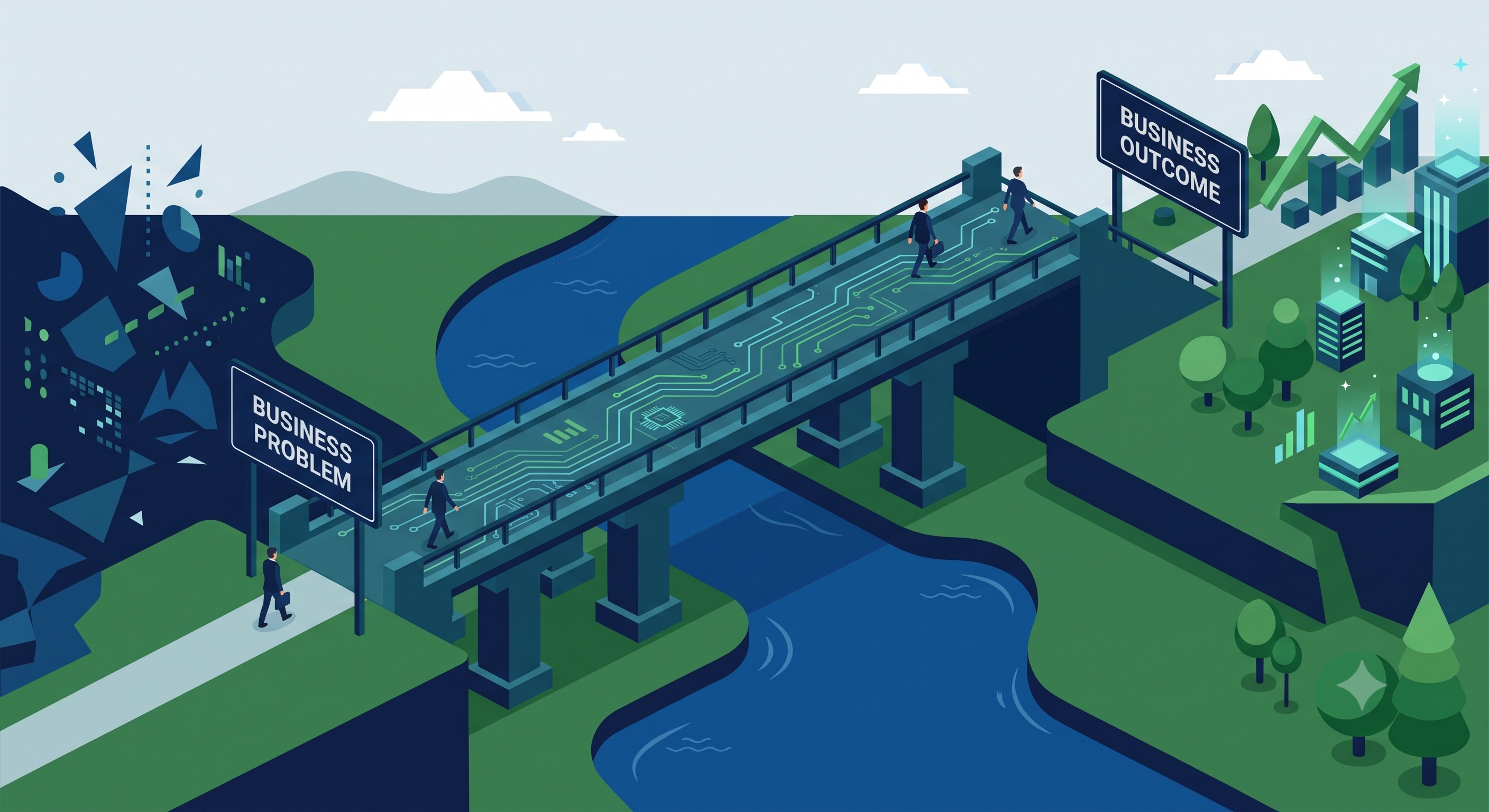
1. Evaluation Before Deployment
Before any AI feature goes live, you need a defined evaluation set: a curated collection of real-world inputs paired with their expected correct outputs. Every change to your AI pipeline must be tested against this set. Without it, you are flying blind — and you will only discover regressions when customers complain.
Think of it as unit tests for AI: you define what “correct” looks like, and you automate the verification of it.
2. Human-in-the-Loop for High-Stakes Decisions
AI should assist human judgment, not replace it on decisions with significant consequences. Design your system around three tiers:
- AI operates fully autonomously on high-volume, low-stakes tasks
- AI drafts outputs for medium-stakes decisions that a human reviews and approves
- Humans make all final decisions on high-stakes outputs, with AI providing supporting context
3. Monitoring and Alerting in Production
Once deployed, your AI solution should be monitored like any other production system. Track these four metrics continuously:
- Output quality — are responses still accurate over time?
- Latency — is the system still responding fast enough?
- Cost — is API consumption within expected bounds?
- Error rate — is the model failing or hallucinating more frequently?
Set automated alerts for any metric that deviates significantly from its baseline.
4. Graceful Degradation
What happens when the AI pipeline goes down? Every AI-dependent feature needs a fallback: either a manual process the team can revert to, or a simpler rule-based system that handles requests at reduced capability. An AI that takes down a core business function when it fails is not a productivity tool — it is a liability.
A Phased Approach to Cost-Effective AI
The single most effective strategy for controlling AI costs and risk is to start small, validate rigorously, and then scale.
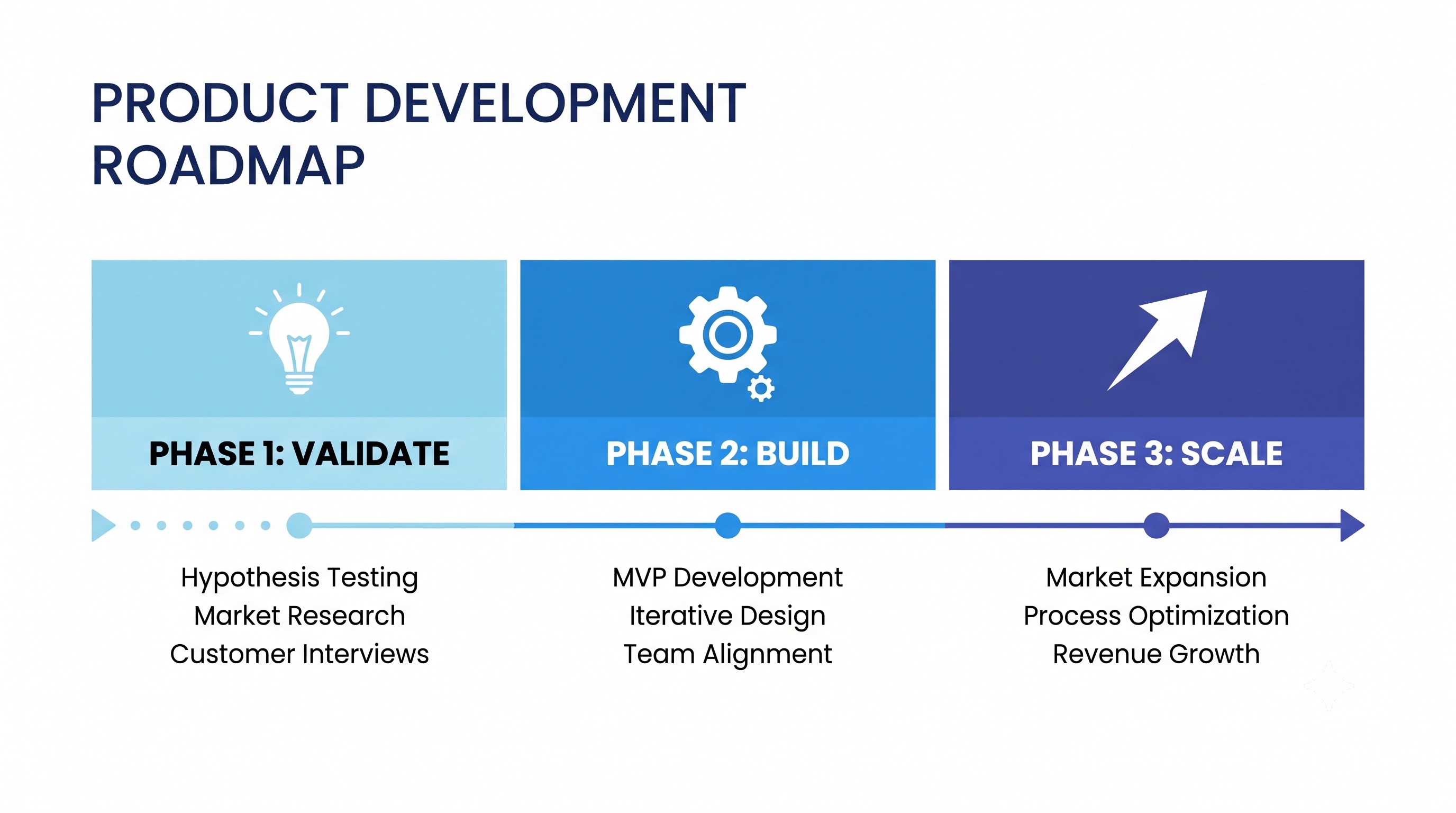
Phase 1 — Validate (2–4 weeks)
Pick one high-value, clearly defined problem. Build a minimal proof-of-concept using existing AI APIs and test it with real business data. Measure the actual improvement. Make a go/no-go decision based on evidence, not excitement.
Phase 2 — Build (1–3 months)
If validation succeeds, build the production version properly: with evaluation sets, monitoring, logging, human-in-the-loop checkpoints, and security controls from day one. This is the phase where engineering discipline pays for itself many times over.
Phase 3 — Scale and Optimize (Ongoing)
Once the system is live and reliable, focus on driving costs down. This typically means switching to a smaller, cheaper model for tasks that do not require a frontier model, implementing caching to avoid redundant API calls, and batching workloads to smooth out consumption.
What Good AI Actually Looks Like in Practice
Across projects we have built for businesses of various sizes, a few patterns consistently deliver high ROI:
- A logistics company automated PDF invoice parsing, eliminating 40+ hours per week of manual data entry — with human review reserved only for the exceptions the AI flagged as uncertain.
- An e-commerce business deployed a product recommendation engine trained on their own customer behavior data, resulting in a 23% increase in average order value.
- A professional services firm built an internal question-answering system over 10 years of archived client contracts, allowing junior staff to draft compliance reports in minutes rather than days.
None of these required a million-dollar budget. All of them started with a precisely defined problem and a disciplined approach to building.
The Bottom Line
AI is a powerful lever — but only if you pull it in the right direction. The businesses that thrive are those who approach AI with the same discipline they apply to any other business investment: define the goal clearly, understand the real cost, build for reliability, and measure everything.
At WebCode Studio, we help businesses cut through the noise and build AI solutions that are engineered for their specific workflows — not retrofitted from a generic vendor template. If you have a process you think could be a candidate for AI, let’s talk.